







From Software Projects to Decision Architecture
Gosign was founded in Hamburg in 2001. For over 25 years, we have built complex software systems for mid-market companies and large enterprises - across more than 5,000 projects for organisations including Airbus, Volkswagen, Shell.
What has changed is not our standards - but the technology.
Our roots are in classical enterprise software: system integration, bespoke platforms, ERP-adjacent development and security-driven architectures. As generative AI emerged, we began testing LLM-based workflows in real enterprise environments - initially experimental, then productive in Azure-based enterprise setups.
Today, we build Enterprise AI Agents and the infrastructure that makes them accountable: the Decision Layer, which breaks every process into individual decision steps and defines for each step: human, ruleset, or AI.
What We Stand For
Decision Quality Over Automation
Enterprises rarely fail because of missing tools. They fail because of inconsistent decision logic.
HR and finance decisions in many organisations are not versioned, not reproducible and dependent on the knowledge of individual employees. Our architecture makes decision logic explicit, traceable and auditable - as a technical layer, not as organisational consulting.
Governance by Design
Compliance is not an afterthought in our work. Our agents are built so that decision logic is versioned, Human-in-the-Loop is architecturally embedded, audit trails are generated automatically and controls exist as data objects. When certification is required, the system is structurally prepared.
More on our Governance pages.
Integration, Not Replacement
We do not replace existing systems. SAP remains ERP. Workday remains the HR platform. SuccessFactors remains the system of record. We add a decision and governance layer - the Decision Layer that makes agents auditable and controllable.
How We Work
Co-Build with Business Functions
Every enterprise has its own compensation logic, its own collective agreements, its own governance requirements and its own ERP structures. That is why we develop AI agents in a Co-Build model with HR, finance and IT - not as a finished product, but configured to the specific processes and rules of the organisation.
Full Source Code Access
Our solutions run in the client’s infrastructure - on Azure, GCP, AWS or self-hosted. No proprietary SaaS model, no vendor lock-in. Full access to source code, configurations, and rule sets. Handover to independent operation after 12-18 months is part of the model.
Gosign is deliberately not a dependency model.
Technologies
Certifications and Competencies
Our team combines over 25 years of enterprise experience with current cloud and AI certifications. Our AI engineers hold Microsoft Azure AI certifications and work daily with LLM APIs, orchestration frameworks and enterprise integration systems.
 Member of the German Federal Association for the Digital Economy (BVDW)
Who We Are
Gosign is owner-managed. 108 employees across offices in Hamburg, Berlin, Kraków, Barcelona, Lisbon and São Paulo. Our largest development centre has been operating in Pakistan since 2002 - founded as a programming school, today an established engineering hub with close ties to the computer science departments at universities in Karachi, Lahore and Islamabad.
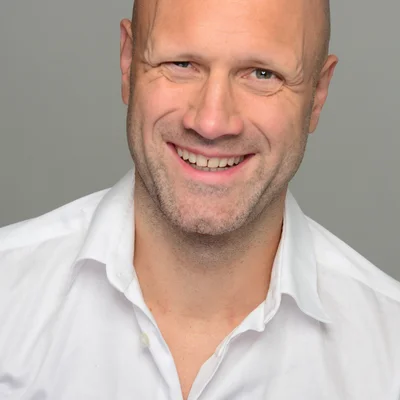
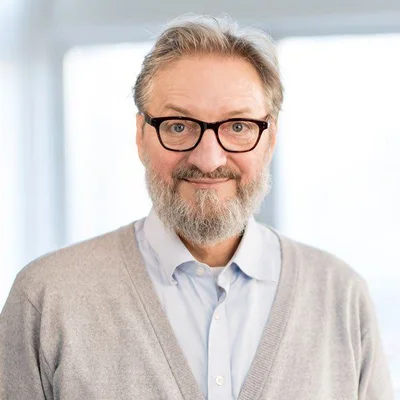
Dieter Gogolin
Managing Director
Bert leads client engagements: from initial analysis through process mapping to architecture decisions. Dieter is responsible for operational and strategic business development - from infrastructure and international development teams to partnership strategy.
Why We Do This
Generative AI is changing how decisions are prepared, documented and accounted for. We believe that AI agents only scale productively when governance is structurally integrated, decision logic becomes explicit and humans remain deliberately involved.
That is what we build the infrastructure for.
All company data at a glance: Facts & Figures