The Form Problem
Expense tools digitise paper forms. The employee fills in, the manager approves, accounting reviews. Three manual steps for a case that could be decided deterministically.
The Travel Decision Layer decomposes every travel expense case into individual decision steps and defines for each: rule engine, collective agreement or human. No LLM decides on amounts. An auditable Decision Layer applies tax rules, country-specific per diems and collective agreement provisions deterministically. Every decision documented, every one reproducible, every one audit-proof.







The Problem
SAP Concur, Circula, Moss, Spendesk. They all solve the same problem: capture receipts, fill out forms, obtain approvals. But in organisations with collective agreements, international staff and dozens of legal jurisdictions, capture is not the problem. The decision is.
Expense tools digitise paper forms. The employee fills in, the manager approves, accounting reviews. Three manual steps for a case that could be decided deterministically.
Country-specific per diem rates, posting rules, meal deductions, collective agreement overrides, tax exemption thresholds. No employee knows all the rules. No approver checks them. Decisions are made on instinct and hope.
When the tax audit comes, the evidence is missing: which rule was applied? Why this per diem? Was the deduction correct? Expense tools document what was submitted. Not why it was decided that way.
The Decision Layer
The Travel Decision Layer works like every Gosign Decision Layer: it decomposes a process into individual decision steps and defines for each step who or what decides. Rule engine, collective agreement, or human. Not everything at once, but step by step, documented and traceable.
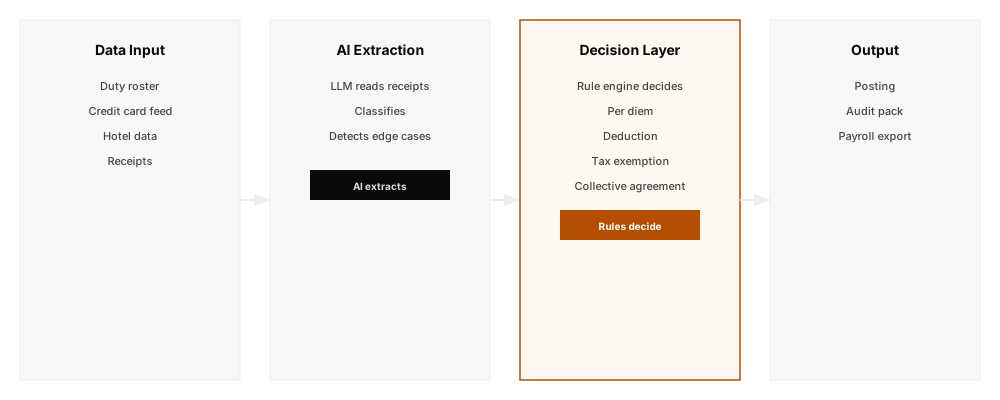
AI extracts and classifies. The Decision Layer decides. This separation is the reason the system is auditable, AI Act compliant and works-council-ready.
Decision tables are versioned. Every case is checked against a defined rule version. No stochastic results, no LLM output for amounts or tax treatment.
Not one big decision 'approved / rejected', but dozens of small ones: which per diem? Which deduction? Which collective agreement? Tax-exempt portion? Each individually documented.
The Decision Layer does not decide everything itself. It knows which steps the rule engine covers, which are defined by collective agreements and where a human must intervene. The result: only genuine exceptions need human attention.
Traditional expense tools ask the employee to confirm their own expense report. The Decision Layer reverses this: processing happens automatically. The employee is informed and has a veto right.
Governance
When the tax auditor asks "Why was 28 EUR applied instead of 14 EUR?", "the system calculated it" is not sufficient. The Travel Decision Layer generates a decision record for every case that answers exactly this question: which rule, which input, which result, when, by whom.
All entries are append-only. Nothing is overwritten, nothing deleted. Sealed audit packs (JSON + PDF, SHA-256 signed) are exportable at any time.
Every rule is visible. Every decision is traceable. Employee representation bodies can inspect the complete rule set and all decision records. No black box, no opaque AI decisions.
Retention periods fully supported (Germany: 10 years AO section 147; varies by jurisdiction). Anonymisation instead of deletion for GDPR compatibility. Every case is reproducible via its input hash at any time.
Not a quarterly report, not a sampling check. Every single case is rule-checked. Deviations are flagged immediately, not discovered months later during reconciliation.
| Dimension | Travel Decision Layer | Traditional Expense Tool |
|---|---|---|
| Decision model | Decision Layer applies rules, human has veto | Human fills in, manager approves |
| Rule complexity | Versioned decision tables: tax rules, per diems, collective agreements | Basic policies, no collective agreement logic |
| Audit trail | Every micro-decision documented: rule, input, result, timestamp | Receipt stored, decision not documented |
| Tax audit | Export: sealed audit pack per case, reproducible via input hash | Manual reconstruction from files |
| Employee experience | Automatic processing, notification, veto option | Form, upload, wait for approval |
| Scalability | Constant: 100 or 100,000 cases, same rule engine | Linear: more cases = more reviewers |
| Works council / employee representation | Transparent rule set, complete audit trail, no opaque AI decisions | Opaque, difficult to audit |
Every industry has its own travel expense logic. The Decision Layer adapts to your collective agreements, your per diem rules, your system landscape. Four industry configurations as starting points.
Every rotation is a tax case. Multiple countries per duty day, crew-specific collective agreements, IROP handling. The Decision Layer is configurable for rotation-based crew expense processing.
Aviation in detailThree-way cost split: tax / client / internal. Multi-client weeks, daily-changing cost centres. The Decision Layer is configurable for project-based consulting expense governance.
Consulting in detailGPS-based country detection, driver per diems, EU Mobility Package compliance data. The Decision Layer is configurable for fleet-based driver expense processing.
Logistics in detail10,000+ cases per month, CRM integration, policy enforcement at scale. The Decision Layer is configurable for high-volume field service expense governance.
Sales in detailEach Decision Map shows how the Travel Decision Layer decomposes a real-world scenario into micro-decisions. Download as PDF, no registration required.
Crew rotations, collective agreements, IROP handling - visualised as a decision flow.
Multi-client weeks, three-way split, policy enforcement - visualised as a decision flow.
GPS country detection, EU Mobility Package, zero-touch mode - visualised as a decision flow.
CRM integration, volume policy, weekly settlement - visualised as a decision flow.
Implementation
The Travel Decision Layer runs on Gosign's enterprise infrastructure: EU data residency, containerised, multi-tenant, no external dependencies. Deployment as managed cloud or in your private cloud.
Infrastructure details →The Decision Layer is not installed but configured: your collective agreements, your policies, your system landscape. Typical pilot projects start within 3 months. Extensions to additional industries or staff groups run in parallel with pilot operations.
Every case rule-checked
No rework from sampling gaps. What passes through is correct.
No approval workflows for standard cases
Throughput time from days to minutes. Managers only approve exceptions.
Automatic cost centre and project assignment
No manual mapping for thousands of cases. No month-end bottleneck.
Audit-proof decision records created within the process
Tax audit is an export, not a research project. Weeks become minutes.
Security
Not retrofitted as a feature, but built as an architecture principle. The Travel Decision Layer is designed for regulated environments where data protection, audit readiness and traceability are not optional extras.
All data remains in EU data centres. No processing in the US. No US Cloud Act risk for personal employee data. (US: For US-only deployments, US-based hosting is configurable.)
Anonymisation instead of deletion. Compatible with tax retention periods and GDPR Art. 17. No conflict between tax law and data protection. (UK: UK GDPR provisions apply equivalently post-Brexit.)
Clear architecture separation: LLM for data extraction, Decision Layer for decisions. No black box over tax matters. Every decision reconstructable.
Signed decision records. Input hash plus rule version yields reproducible result. Sealed audit packs (JSON + PDF, SHA-256). Tax audit ready at any time.
Integrated controls registry, automated evidence runs, versioned policies. Compliance in running operations, not documented after the fact.
Integration with existing identity providers. Tenant isolation at database level (row-level security). Role model granularly configurable.
Concur is a capture and workflow tool. The employee fills in a form, the manager approves. The Travel Decision Layer is a decision layer: it decides deterministically based on rule engines, documents every decision and generates audit-proof decision records. Concur digitises the paper process. The Decision Layer replaces it.
No. The Decision Layer sits between source systems and ERP. It reads data from duty rosters, credit card feeds and receipts, makes decisions and delivers posting-ready results to SAP, Oracle, or any ERP system.
Collective agreement rules are configured per client project. The Decision Layer can map collective agreement per diem rates that override statutory rates. The mapping of your specific collective agreement logic is developed together during implementation.
Decision tables are versioned. New rule sets are deployed as their own version, with a validity period. Retroactive changes trigger automatic recalculation of all affected cases.
Yes. Every decision is auditable, the rule set is inspectable, and the complete audit trail is accessible to employee representation bodies. The Decision Layer makes no opaque AI decisions. It applies documented rules.
We configure the Decision Layer with your real-world scenarios: your collective agreements, your jurisdictions, your typical travel cases. You see live how every case is decomposed into micro-decisions and which rules apply. Not a generic demo, but your cases.
None. The Decision Layer runs in EU data centres with full data residency. Personal data is processed exclusively within the EU. (US: US-based hosting is configurable for US-only deployments.)
Typical pilot projects start within 3 months: one industry, one collective agreement, one data flow. Extensions to additional staff groups or system connections run in parallel with pilot operations.
In the Industry Simulation, we configure the Decision Layer with your real-world scenarios: your collective agreements, your jurisdictions, your typical travel cases.
Request Industry Simulation