AI Agents for Business-Critical Processes
Document Agents. Workflow Agents. Knowledge Agents.








At a Glance
3 Agent Types
Document, Workflow, Knowledge - each with its own Decision Layer
4-6 Weeks
From Discover to productive PoC in your infrastructure
85-92% Zero-Touch
Routine cases processed autonomously - exceptions escalated to humans
7+ LLMs
Model-agnostic: Claude, ChatGPT, Gemini, Llama, Mistral, DeepSeek
Full Source Code
No SaaS, no vendor lock-in - you own the code, prompts, and rule sets
EU AI Act Ready
Audit trail, Human-in-the-Loop, governance framework constraints
Building an agent is easy. Making it enterprise-ready is not.
Workflow agents can be prototyped in days. The real problem starts afterward: Is the agent's decision auditable? Does it meet EU AI Act requirements? Can employee representation bodies trace the rules the agent follows?
That is exactly where we come in. Not building the agent itself - but the governance layer that makes it production-ready, auditable, and certifiable. Enterprise processes rely on implicit knowledge: collective agreements, company policies, posting logic. An AI Agent structures these decisions, documents them, and makes them reproducible - across all locations and case workers.
Three Agent Types
Every business process can be broken down into three tasks: understanding documents, coordinating workflows, and providing knowledge. Three specialized agent types handle these - each with its own Decision Layer and audit trail.
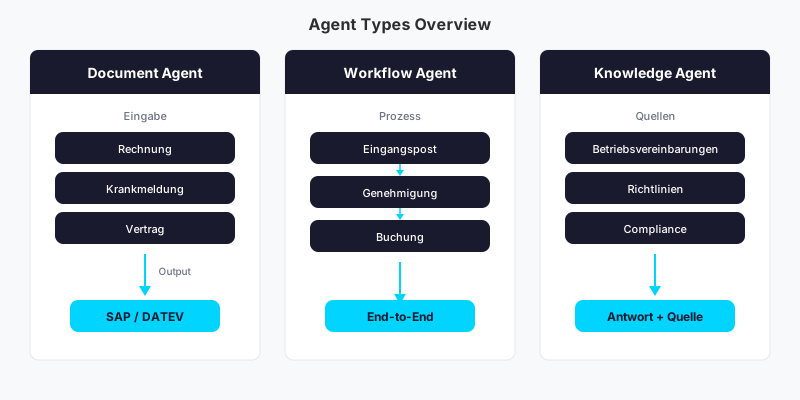
| Document Agent | Workflow Agent | Knowledge Agent | |
|---|---|---|---|
| Role | The Specialist | The Coordinator | The Knowledge Keeper |
| Task | Read, understand, and classify documents | Orchestrate processes across system boundaries | Answer questions from internal rule sets |
| Replaces | OCR + template matching | RPA + manual workflows | Search engine + chatbot |
| Example | Extract and classify a sick note | Coordinate onboarding across SAP, AD, and email | Answer leave entitlement with source citation |
Document Agents
The Specialist: understands documents with genuine language comprehension. No template recognition - contextual understanding of invoices, sick notes, and contracts. The Decision Layer evaluates every extraction and routes low-confidence results to a case worker.
Human-in-the-Loop
Agent decides: Standard documents with high confidence (invoices with clear line items, sick notes with unambiguous dates).
Human decides: Ambiguous documents, deviating amounts, first-time suppliers, documents with free-text clauses. The agent prepares and recommends - the final approval rests with the case handler.
Workflow Agents
The Coordinator: orchestrates processes across systems. SAP, DATEV, SharePoint, Active Directory - one agent coordinates the entire flow via APIs. On queries, the workflow pauses, a human decides, and the agent resumes exactly where it left off.
Human-in-the-Loop
Agent decides: Routing, system bookings, status updates, notifications - all according to defined rules in the Decision Layer.
Human decides: Personnel decisions (hiring, termination, transfer), budget approvals above thresholds, exceptions to company agreements. The workflow pauses until the human has decided.
Knowledge Agents
The Knowledge Keeper: answers questions from enterprise knowledge - company policies, collective agreements, compliance rules. Every answer with source citation and rule version. Without a verified source, no answer - the architecture prevents hallucination.
Human-in-the-Loop
Agent decides: Standard queries with clear source base (leave entitlement, notice period, responsibilities).
Human decides: Interpretation questions with conflicting rule sets, individual case assessments, questions about ongoing negotiations. When uncertain, the agent does not answer but escalates with context to the responsible domain expert.
Working Together: Three Agents, One Process
In practice, the three agent types work together. A Workflow Agent orchestrates the overall process and calls Document Agents and Knowledge Agents as specialists when needed.
Example: Sick Note End-to-End
- Document Agent detects the sick note in the email inbox, extracts the employee name, period, and diagnosis code.
- Workflow Agent checks the HR system: is this the third notification within six months?
- Knowledge Agent is called: "At what threshold does the reintegration requirement apply under the current collective agreement?"
- Workflow Agent evaluates the answers: threshold not reached - standard process applies.
- Decision Layer checks statutory constraints and governance framework requirements - calculate continued pay.
- Workflow Agent creates the SAP posting proposal, notifies the HR manager, and documents everything in the audit trail.
Six steps, three agent types, three systems - one continuous audit trail.
Which agent type fits your process?
30 minutes. Your process. A concrete recommendation.
Schedule a consultationSpecialized Agent Solutions
Document, Workflow, and Knowledge Agents are the building blocks. For HR and Finance, we offer pre-configured solutions with industry-specific rule sets. For other domains, we develop custom agents in a Co-Build model.
HR & People Operations
HR AI Agents
6 agent products: Payroll, Travel, Recruiting, Leave, Lifecycle, Screening. Governance-ready.
Assess 48 agents →
OverviewFinance & Accounting
Finance AI Agents
Document processing, account assignment, depreciation logic, correction postings. SAP and DATEV integration.
Assess 49 agents →
OverviewCustom Agents
Co-Build
Your process, your agent. 4-6 weeks from Discover to a productive agent with full source code access.
DetailsNext Step
Schedule a Consultation
30 minutes. Your use case. A concrete recommendation on which agent type fits.
Schedule a consultationWho It's For
AI agents affect different stakeholders. Each has different questions.
CHRO / VP HR
Governance-ready automation of HR processes - Payroll, Leave, Recruiting - with full audit trail and collective agreement compliance.
CFO / Finance Lead
Automated document processing, account assignment, and reconciliation - consistent across all locations, auditable for external auditors.
Employee Oversight Bodies
Works councils, employee representation bodies, or compliance committees: full transparency over every agent decision. The Decision Layer maps governance frameworks as explicit constraints. Human-in-the-Loop where it matters.
CTO / IT Lead
Model-agnostic architecture. API-based integration with SAP, DATEV, Workday. No vendor lock-in, full source code access.
Decision Layer
The Decision Layer breaks every business process into individual decision steps and defines for each step: human, rule set, or AI. Every decision is documented - traceable for auditors, employee representation bodies, and internal compliance.
Different for each agent type: for Document Agents, it checks extraction quality. For Workflow Agents, it controls routing. For Knowledge Agents, it prevents hallucination.
Integration and Model Agnosticism
AI agents do not replace existing systems. SAP remains ERP. Workday remains HCM. DATEV remains tax system. Agent logic is decoupled from the target system.
The architecture is not tied to a single LLM: Claude, ChatGPT, Gemini, Llama, Mistral, DeepSeek - models are interchangeable without changing the business logic. No vendor lock-in.
Business Impact
- Routine cases processed autonomously - with complete documentation
- Consistent rule interpretation across all locations
- Every decision traceable for auditors and employee representation bodies
- Scalable without proportional headcount increase
Full access to the source code, all prompts, and all rule sets. After 12-18 months, you operate your agents independently. No SaaS subscription, no platform lock-in.
Deep Dive in the Agent Briefing
Our article series for decision-makers implementing AI agents in the enterprise.
Frequently Asked Questions about AI Agents
What data leaves the company?
None. Agents run in your infrastructure - cloud, self-hosted, or hybrid. With cloud LLMs, the respective provider's DPAs apply. With self-hosted models, no data leaves your network.
How long does a pilot project take?
4-6 weeks to a productive PoC. Discover (1 week), Build (3-4 weeks). The first agent runs live in your infrastructure with Decision Layer and audit trail.
Is this compliant with employee oversight requirements?
Yes. Human-in-the-Loop as architectural principle, complete logging, role concept, audit trail. Governance frameworks - collective agreements, works agreements, or company policies - are mapped as explicit constraints in the Decision Layer.
Which models are used?
The architecture is model-agnostic. Currently: Claude, ChatGPT, Gemini, Llama, Mistral, DeepSeek, gpt-oss. Models are interchangeable without changing the business logic.
How do the three agent types work together?
A Workflow Agent orchestrates the overall process and calls Document Agents (for document processing) and Knowledge Agents (for rule-set queries) as needed. Each agent has its own Decision Layer, and the Workflow Agent coordinates results across system boundaries.
Which process should your first agent handle?
30 minutes. Your use case. Concrete recommendation on which agent type fits.